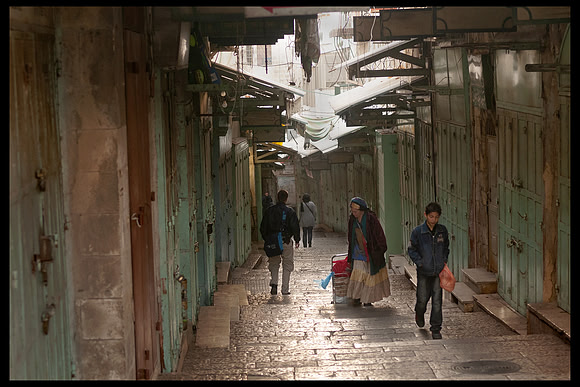
11-0089 Jerusalem
Early Morning in the Armenian Quarter - February 2010
Until 1860, the walled Old City, which is only 0.9 square km (0.35 sq mi), constituted the entirety of Jerusalem. The modern city of Jerusalem has since grown up outside the Old City walls. The Old City's current defensive walls and city gates were built in the years 1535–1542 by the Turkish sultan Suleiman the Magnificent. It is home to several sites of religious importance including: the Temple Mount and Western Wall, the Church of the Holy Sepulchre, and the Dome of the Rock and Al-Aqsa Mosque. It is a UNESCO World Heritage Site.
Jerusalem is divided into four uneven quarters, which were introduced in the 19th century: the Muslim Quarter, Christian Quarter, Armenian Quarter, and Jewish Quarter.
The Armenian Quarter is the smallest of the four. Although the Armenians are Christian, they are an independent group and form a vigorous presence in the Old City. The 1967 Six-Day War, in which Israel gained all of Jerusalem and the West Bank, is remembered by residents of the quarter as a miracle—two unexploded bombs were found inside the Armenian monastery. Interestingly, the Israeli government paid for repairs to all churches or holy sites damaged in the fighting, regardless of who caused the damage.
Copyright 2010 - www.ockenphotography.com