10-2019SoldierWestenWall
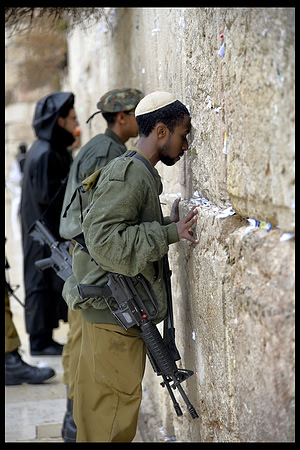
Soldier at the Western Wall - February 2017
The Western Wall, also known as Kotel, and in Islam as the Buraq Wall, is an ancient limestone brick wall in the Old City. The public part is a relatively small segment of a far longer ancient retaining wall, known in its entirety as the “Western Wall.” For Muslims, it is believed to be the site where the Islamic prophet Muhammad ascended to paradise, and constitutes the Western border of al-Haram al-Sharif, the Muslims’ name for the Temple Mount.
The Western Wall is considered holy in the Jewish tradition because it is the public access to the Temple Mount. Because of the Temple Mount’s entry restrictions, the Wall is the holiest place Jews are permitted to pray, but the holiest site in the Jewish faith lies behind it, where the temple once stood. Of the four retaining walls, the western one is considered the closest to the former temple, which makes it the most sacred.
Just over half the wall's total height is now located below street level, and the wall is believed to have been built around 19 BCE. This dates from the end of the second temple period, although recent excavations indicate that the work was not finished by the time Herod died in 4 BCE. The very large stone blocks of the lower courses are Herodian, the courses of medium-sized stones above them were added during the Umayyad era, and the small stones of the uppermost courses are of more recent date, from the Ottoman period.
Copyright 2017 - www.ockenphoto.com