04-WesternWallRocks
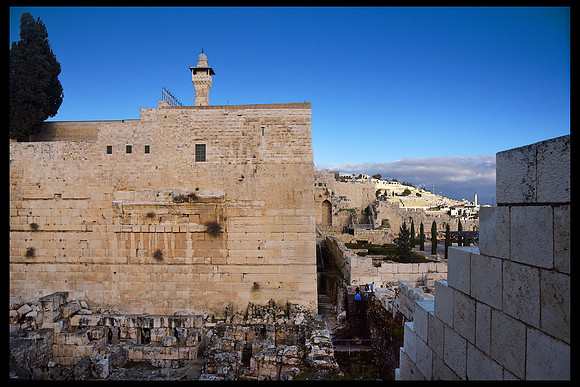
Remains of the Second Temple - February 2017
The Temple Mount and the Al-Aqsa compound comprise a relatively manmade hill located in the Old City of Jerusalem. For thousands of years, it has been known as a holy site in Judaism, Christianity, and Islam alike.
The present site is a flat plaza surrounded by retaining walls, which include the Western Wall, built during the reign of Herod the Great. There are three monumental structures on the Temple Mount: the Al-Aqsa Mosque, the Dome of the Rock, and the Dome of the Chain, as well as four minarets. Herodian walls and gates—with additions from the late Byzantine and early Islamic periods—create the base of the Mount. Currently it can be accessed through eleven gates: ten reserved for Muslims and only one for non-Muslims, with Israeli police guarding each entrance.
According to Jewish tradition and scripture, the first temple was built by King Solomon, the son of King David, in 957 BCE, and destroyed by the Babylonians in 586 BCE. However, there is no substantial archaeological evidence to verify this. The even larger second temple was constructed during Zerubbabel’s rule in 516 BCE and was destroyed by the Roman Empire in 70 CE. Jewish tradition maintains that on this site a third and final temple will be built. This makes it by far the holiest site in Judaism and the place Jews turn toward during prayer. Due to its extreme sanctity, many Jews will not enter the Mount, as they wish to avoid unintentionally standing where the Holy of Holies once stood. According to Rabbinical law, some aspect of the Divine Presence is still present at that site.
Copyright 2017 - https://www.ockenphotography.com/